









Night Vision vs Thermal Imaging: Which Is Better for Outdoor Observation and Surveillance?
When choosing equipment for nighttime observation, hunting, surveillance, security, or search and rescue operations, users often face an important question:
Should I choose Night Vision or Thermal Imaging?
Both technologies are designed to improve visibility in low-light environments, but they operate in completely different ways and offer unique advantages depending on the application.
In this guide, Injie Optics explains the differences between Night Vision and Thermal Imaging to help users select the best solution for their needs.
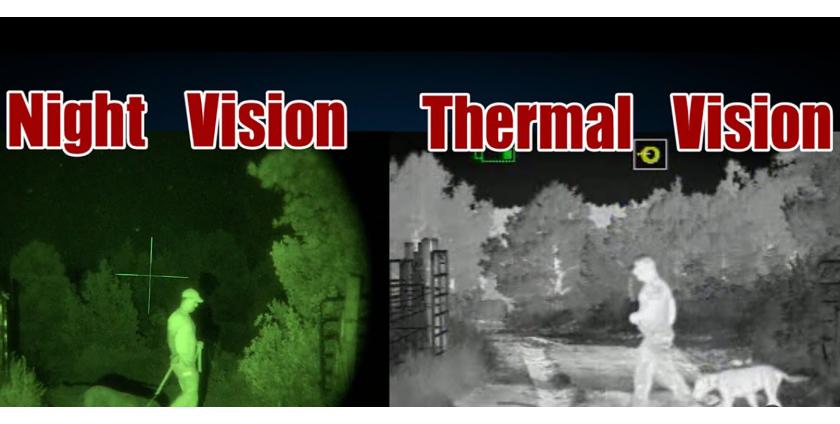
Understanding Night Vision Technology
Night vision devices amplify available light to create a visible image.
These systems utilize:
- Moonlight
- Starlight
- Ambient light sources
- Infrared illuminators (optional)
The collected light is amplified thousands of times to provide a clearer image in darkness.
Advantages of Night Vision
✔ Natural-looking image
✔ Excellent detail recognition
✔ Lower cost compared to thermal imaging
✔ Suitable for navigation and observation
✔ Effective in low-light conditions
Limitations of Night Vision
✘ Performance decreases in complete darkness without IR illumination
✘ Difficult to detect concealed targets
✘ Reduced effectiveness in fog, smoke, and dense vegetation
✘ Can be affected by bright light exposure
Understanding Thermal Imaging Technology
Thermal imaging devices detect infrared heat emitted by objects and living beings.
Unlike night vision, thermal imaging does not require visible light.
Every object produces heat energy, and thermal sensors convert this information into a visible thermal image.
Advantages of Thermal Imaging
✔ Works in total darkness
✔ Detects heat signatures instantly
✔ Performs well through smoke and light fog
✔ Easier target detection at long distances
✔ Excellent for locating people, animals, and vehicles
Limitations of Thermal Imaging
✘ Higher purchase cost
✘ Less natural image appearance
✘ Limited ability to identify fine visual details
✘ Glass and certain materials may block thermal signatures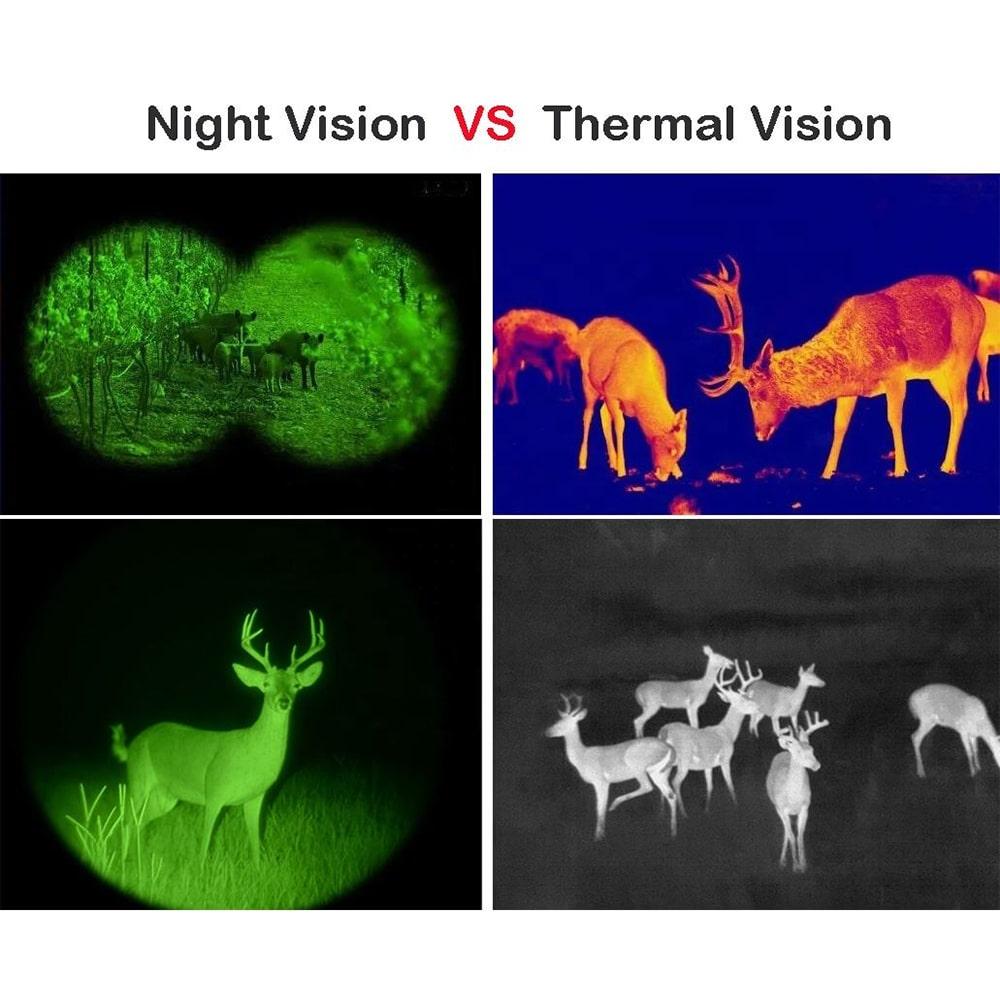
Night Vision vs Thermal Imaging: Key Differences
| Feature | Night Vision | Thermal Imaging |
|---|---|---|
| Requires Light | Yes | No |
| Works in Total Darkness | Limited | Excellent |
| Detects Heat | No | Yes |
| Image Detail | Excellent | Moderate |
| Target Detection | Good | Outstanding |
| Through Smoke/Fog | Limited | Better |
| Long-Range Detection | Moderate | Excellent |
| Cost | Lower | Higher |
Which Technology Is Better for Hunting?
Night Vision for Hunting
Night vision is suitable when:
- Identifying animal details
- Navigating terrain
- Hunting in open areas with available ambient light
Thermal Imaging for Hunting
Thermal imaging is ideal when:
- Locating animals quickly
- Hunting at night
- Detecting animals hidden in vegetation
- Monitoring large areas
Many professional hunters prefer thermal imaging because target detection is significantly faster.
Which Is Better for Security and Surveillance?
For surveillance applications, thermal imaging generally offers greater advantages.
Security personnel can:
- Detect intruders at long distances
- Monitor large areas
- Operate effectively day and night
- Improve threat detection capabilities
Thermal imaging is widely used for:
- Border security
- Critical infrastructure protection
- Perimeter monitoring
- Maritime surveillance
Search and Rescue Applications
Search and rescue teams often rely on thermal imaging because people emit strong heat signatures.
Thermal systems help rescuers:
- Locate missing individuals
- Detect victims in darkness
- Search large areas efficiently
- Improve rescue response times
Night vision can assist with navigation, but thermal imaging is typically more effective for locating targets.
Why Many Professionals Use Both Technologies
Rather than choosing one technology exclusively, many organizations combine both systems.
A common approach includes:
Thermal Imaging
Used for:
- Detection
- Initial target acquisition
- Area scanning
Night Vision
Used for:
- Target identification
- Navigation
- Detailed observation
Together, they provide a complete surveillance solution.
Injie Optics Night Vision and Thermal Imaging Solutions
Injie Optics offers a complete range of observation equipment including:
Thermal Imaging Devices
- Thermal monoculars
- Thermal binoculars
- Thermal rifle scopes
- Thermal rangefinders
Night Vision Devices
- Digital night vision monoculars
- Night vision binoculars
- Night vision scopes
- Infrared observation systems
Integrated Solutions
Advanced models combine:
- Thermal imaging
- Laser rangefinders
- Ballistic calculators
- Video recording
- Wireless connectivity
These systems provide superior performance for professional users.
Future Trends
The future of observation technology is moving toward multi-sensor integration.
Emerging products will combine:
- Thermal imaging
- Night vision
- Laser ranging
- Artificial intelligence
- Automatic target tracking
This integrated approach will significantly improve detection, identification, and operational efficiency.
Conclusion
The answer to the question "Night Vision vs Thermal Imaging: Which Is Better?" depends on the application.
If your primary goal is target detection in difficult environments, thermal imaging is often the superior choice.
If you require detailed visual identification and navigation capability, night vision remains highly effective.
For maximum performance, many professionals choose systems that combine both technologies.
Injie Optics provides advanced night vision and thermal imaging solutions designed to meet the needs of hunters, security professionals, rescue teams, and outdoor enthusiasts around the world.