









How Binocular Laser Rangefinders Improve Power Line Inspection Efficiency and Safety
Power transmission and distribution networks extend across mountains, forests, rivers, deserts, and urban areas. Maintaining these assets requires regular inspections to ensure operational safety, minimize outages, and extend infrastructure life.
Traditional inspection methods often require engineers to work at close range or climb transmission towers, increasing labor costs and safety risks. Today, binocular laser rangefinders provide a safer and more efficient alternative by combining high-definition observation with precision laser measurement.
These advanced optical instruments allow utility professionals to inspect equipment from a safe distance while collecting accurate measurement data in real time.
Challenges in Modern Power Line Inspection
Power utilities face several common challenges during routine inspections:
Long inspection routes across difficult terrain
High-voltage safety risks
Limited access to remote transmission towers
Dense vegetation near power lines
Adverse weather conditions
Time-consuming manual measurements
To address these issues, utility companies are increasingly adopting intelligent optical equipment that improves both efficiency and worker safety.
Why Use Binocular Laser Rangefinders?
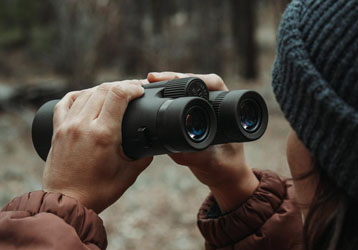
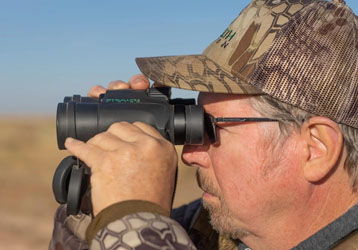
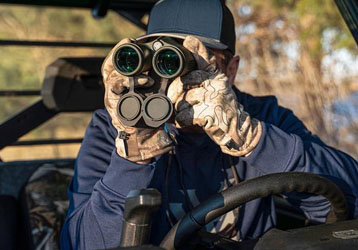
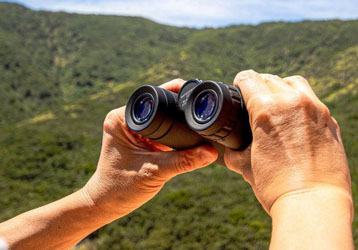
Unlike conventional binoculars, binocular laser rangefinders integrate observation and measurement into a single device.
Field engineers can quickly identify potential issues while measuring:
Distance to transmission towers
Tower height
Horizontal distance
Clearance between conductors and vegetation
Span length
Inspection target location
This eliminates the need for multiple measuring tools and reduces inspection time.
Key Applications in Utility Inspection
Transmission Tower Inspection
Inspectors can observe towers from a safe location to identify:
Structural deformation
Corrosion
Loose components
Damaged crossarms
Missing fasteners
Laser distance measurement helps estimate inspection distances and supports maintenance planning.
Vegetation Management
Tree branches growing near power lines are a major cause of electrical outages.
A binocular laser rangefinder enables crews to:
Measure tree height
Estimate clearance distance
Monitor vegetation growth
Plan trimming operations
This helps utilities comply with vegetation management standards while reducing wildfire and outage risks.
Conductor Clearance Assessment
Maintaining proper clearance between conductors and surrounding objects is essential for safe operation.
Using angle measurement and horizontal distance calculation, inspectors can quickly evaluate:
Ground clearance
Road crossing clearance
River crossing clearance
Building proximity
Obstacle distance
Accurate measurements support informed maintenance decisions.
Substation Inspection
Large substations contain complex electrical equipment that often requires observation from secure locations.
Engineers can inspect:
Transformers
Circuit breakers
Busbars
Disconnect switches
Support structures
The optical system provides clear images while laser measurement assists with maintenance documentation.
Advantages of Using Binocular Laser Rangefinders
Improved Safety
Inspectors can remain outside hazardous areas while collecting accurate field data.
Increased Efficiency
Observation and measurement are completed simultaneously, reducing inspection time.
High Measurement Accuracy
Professional laser ranging technology delivers reliable distance information for engineering analysis.
Reduced Equipment Load
One device replaces multiple traditional tools, making field operations more efficient.
Better Decision-Making
Real-time measurement data enables faster maintenance planning and resource allocation.
Recommended Features for Utility Professionals
When selecting a binocular laser rangefinder for power inspection, consider the following specifications:
Long-range laser measurement
ED optical glass
Fully Multi-Coated lenses
BAK4 prism system
Horizontal distance calculation
Height measurement
Continuous scan mode
Electronic compass
Bluetooth connectivity
IP67 waterproof rating
Fogproof construction
Shock-resistant housing
Long battery life
These features improve reliability under demanding field conditions.
Why Choose INJIE Optics?
INJIE Optics designs professional optical solutions for utility companies and infrastructure operators worldwide.
Our binocular laser rangefinders are engineered to provide:
High-definition optical performance
Long-distance laser measurement
Stable ranging accuracy
Rugged outdoor durability
Intelligent measurement modes
OEM & ODM customization
Reliable after-sales support
Our products help inspection teams improve operational efficiency while enhancing workplace safety.
Conclusion
Power utilities require reliable tools capable of delivering accurate measurements under challenging conditions.
Binocular laser rangefinders combine premium optics with advanced laser technology, enabling engineers to inspect transmission lines, substations, and surrounding infrastructure more safely and efficiently.
As smart grid development continues worldwide, professional optical measurement equipment will play an increasingly important role in predictive maintenance and infrastructure management.
INJIE Optics remains committed to delivering innovative optical technologies that help utility professionals inspect smarter, measure accurately, and operate safely.
Frequently Asked Questions
What is a binocular laser rangefinder used for in power line inspection?
It is used to observe transmission infrastructure and measure distances, tower heights, conductor clearance, and surrounding vegetation without requiring close physical access.
Why is laser distance measurement important for utility inspections?
Accurate distance information improves maintenance planning, enhances safety, and supports regulatory compliance.
Can binocular laser rangefinders be used in harsh weather?
Professional models are typically designed with waterproof, fogproof, and shock-resistant construction, making them suitable for demanding outdoor environments.
What industries besides power utilities use binocular laser rangefinders?
They are also widely used in forestry, industrial surveying, security, environmental monitoring, hunting, wildlife observation, marine patrol, and outdoor exploration.