









Laser Rangefinder Accuracy Explained: What Affects Measurement Precision?
When purchasing a professional laser rangefinder, one of the first specifications buyers examine is measurement accuracy. Product datasheets often list values such as ±0.5 m, ±1 m, or ±0.3 m, but what do these numbers actually mean in real-world applications?
More importantly, why can two laser rangefinders with similar specifications perform differently in the field?
The answer lies in a combination of optical engineering, laser technology, signal processing, environmental conditions, and user operation.
In this guide, we'll explain the key factors that influence laser rangefinder accuracy, common sources of measurement error, and practical tips for obtaining reliable results.
What Does Measurement Accuracy Mean?
Measurement accuracy describes how closely the displayed distance matches the actual distance to the target.
For example:
-
A specification of ±1 m means the measured value is expected to fall within one meter of the actual distance under the manufacturer's specified test conditions.
-
Real-world performance depends on target characteristics, environmental conditions, and correct operation.
Accuracy should not be confused with repeatability, which refers to the ability to obtain consistent results across repeated measurements.
Key Factors Affecting Laser Rangefinder Accuracy
1. Target Reflectivity
The amount of laser energy reflected back to the receiver depends on the target surface.
High-reflectivity targets:
-
Painted walls
-
Metal panels
-
Reflective markers
Low-reflectivity targets:
-
Dark vegetation
-
Black rubber
-
Rough stone surfaces
Highly reflective targets generally provide stronger return signals and more stable measurements.
2. Measuring Distance
As distance increases:
-
The laser beam spreads.
-
The reflected signal becomes weaker.
-
Atmospheric effects become more significant.
Professional long-range laser rangefinders use advanced optics and signal processing to maintain reliable performance over extended distances.
3. Atmospheric Conditions
Environmental conditions play an important role in laser measurement.
Performance may be affected by:
-
Heavy rain
-
Dense fog
-
Snow
-
Dust
-
Heat shimmer
-
Strong sunlight
Whenever possible, measurements should be taken under stable environmental conditions.
4. Beam Divergence
Laser beams gradually expand over distance.
A smaller beam divergence generally improves:
-
Target isolation
-
Signal concentration
-
Long-range measurement performance
This is particularly important when measuring small or distant objects.
5. Optical System Quality
A professional optical system includes:
-
Multi-coated lenses
-
Precision alignment
-
High-transmission optical glass
Superior optics help users identify targets more clearly and improve measurement consistency.
6. Signal Processing Algorithms
Modern laser rangefinders use advanced digital processing to:
-
Filter background interference
-
Analyze return signals
-
Reject false reflections
-
Improve target recognition
Software plays an increasingly important role in overall measurement performance.
7. User Technique
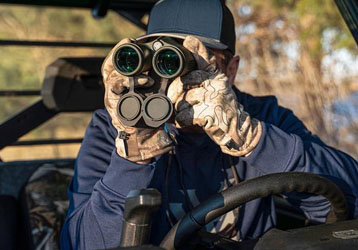
Even the most advanced laser rangefinder depends on proper operation.
For best results:
-
Hold the instrument steadily.
-
Aim at a stable target.
-
Avoid measuring through glass or dense vegetation.
-
Repeat measurements when verifying critical distances.
-
Use a tripod for long-range observations whenever practical.
Common Sources of Measurement Error
Understanding common errors helps improve measurement reliability.
Multiple Reflective Surfaces
If the laser beam strikes more than one object, the receiver may detect multiple reflections.
Examples include:
-
Fences
-
Tree branches
-
Utility wires
Weather Interference
Rain, fog, and airborne particles scatter laser energy, reducing signal strength.
Moving Targets
Vehicles, machinery, and wildlife can change position during measurement, affecting results.
Dirty Optics
Dust, fingerprints, or moisture on the optical windows reduce transmission efficiency.
Regular cleaning is recommended.
Low Battery Power
Although modern devices manage power efficiently, maintaining adequate battery charge helps ensure stable performance.
Accuracy vs. Maximum Measuring Distance
Maximum advertised range does not necessarily indicate better measurement quality.
Professional buyers should evaluate:
-
Measurement accuracy
-
Beam divergence
-
Optical quality
-
Receiver sensitivity
-
Signal processing
-
Overall system reliability
A balanced optical system often delivers better field performance than one optimized solely for maximum range.
Applications Requiring High Accuracy
Surveying
-
Property boundaries
-
Infrastructure projects
-
Topographic surveys
Construction
-
Building layout
-
Structural verification
-
Site planning
Utility Inspection
-
Power transmission towers
-
Substations
-
Pipeline infrastructure
Forestry
-
Tree height estimation
-
Forest inventory
-
Habitat monitoring
Industrial Inspection
-
Equipment positioning
-
Factory maintenance
-
Safety inspections
How INJIE Optics Enhances Measurement Accuracy
At INJIE Optics, measurement accuracy is achieved through the integration of multiple technologies.
Precision Optical Design
Optimized optical systems improve target visibility and laser transmission.
Advanced Laser Modules
Stable laser emitters provide consistent signal quality.
Intelligent Signal Processing
Digital algorithms enhance target recognition and reduce interference.
Precision Manufacturing
Accurate optical alignment supports repeatable performance across production batches.
Comprehensive Quality Inspection
Products undergo functional testing and quality verification before shipment.
OEM & ODM Solutions
INJIE Optics supports global partners with flexible OEM and ODM manufacturing services.
Our capabilities include:
-
Private-label production
-
Product customization
-
Optical system optimization
-
Hardware development
-
Software integration
-
Packaging and documentation
We work with distributors, importers, and equipment brands worldwide.
Frequently Asked Questions
Does a higher maximum range mean higher accuracy?
Not necessarily. Maximum range and measurement accuracy are separate specifications. Both should be evaluated together with optical quality and system design.
Can weather affect laser measurement accuracy?
Yes. Rain, fog, snow, dust, and atmospheric turbulence can reduce signal strength and influence measurement reliability.
Why do repeated measurements sometimes differ slightly?
Minor variations may result from target reflectivity, environmental conditions, hand stability, or normal measurement tolerance.
Does INJIE Optics provide customized laser measurement solutions?
Yes. We offer OEM and ODM services, including hardware customization, optical design, branding, and technical support.
Conclusion
Laser rangefinder accuracy depends on much more than a single specification. Target characteristics, optical quality, beam divergence, signal processing, environmental conditions, and user operation all contribute to real-world performance.
By combining precision optical engineering, advanced laser technology, intelligent algorithms, and strict quality control, INJIE Optics develops professional laser rangefinders that deliver dependable measurement performance across engineering, surveying, utilities, forestry, industrial inspection, and outdoor applications.
INJIE Optics — Delivering Accurate Measurements Through Precision Optical Engineering.