









Long-Range Rangefinder Guide: Choosing the Right Device for Accurate Distance Measurement
A long-range rangefinder is a useful tool for measuring the distance between an operator and a distant target. It is commonly used in outdoor environments where conventional measuring tools are inconvenient or unable to provide practical results.
With improvements in laser technology, optical systems, electronic components, and digital displays, modern long-range rangefinders can provide fast distance measurement in a compact handheld design.
What Is a Long-Range Rangefinder Used For?
The primary purpose of a long-range rangefinder is to obtain distance information from a remote target.
Instead of physically moving toward the target, an operator can remain at a suitable observation point and use the rangefinder to measure the distance.
This makes long-range rangefinders useful for:
Outdoor observation
Engineering inspection
Construction site assessment
Land and terrain observation
Forestry work
Facility inspection
Outdoor recreation
Field operations
The specific application determines which rangefinder specifications are most important.
Long-Range Laser Rangefinder Technology
Laser distance measurement is one of the most widely used technologies in modern rangefinders.
The measurement process begins when the device sends a laser signal toward the selected target. The signal reflects from the target surface and returns to the device. The internal electronics then process the returned signal and calculate the target distance.
The result is displayed on the device, allowing the operator to obtain distance information quickly.
This technology eliminates the need for physical measuring tapes or direct access to distant targets.
Why Optical Performance Matters
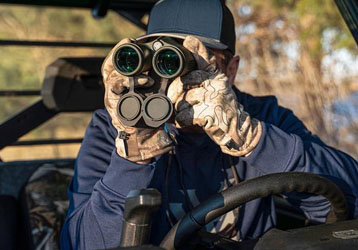
A long-range rangefinder is not only a measuring instrument. In many applications, the operator must first identify a small or distant target before measuring its distance.
A clear optical system can therefore improve the overall user experience.
Good optical visibility helps users:
Locate distant objects
Identify the correct measurement target
Maintain a stable aiming position
Observe targets in open environments
Reduce unnecessary repeated measurements
For long-distance applications, optical clarity can be just as important as the measurement function itself.
Long-Range Rangefinder for Construction
Construction sites often contain large structures, open spaces, and difficult-to-access measurement points.
A portable rangefinder can help workers quickly assess distances between different locations or structures.
For example, an operator may use a long-range rangefinder to obtain distance information between a working position and a distant building section, tower, wall, or other visible reference point.
The device can serve as an auxiliary tool alongside professional surveying equipment.
Long-Range Rangefinder for Forestry
Forestry and woodland environments can present challenges for conventional distance measurement.
Trees may be distributed across large areas, while terrain can make direct access difficult.
A long-range rangefinder can assist with distance assessment between observation points and visible targets. When combined with optical observation, it can help users identify and evaluate distant objects more efficiently.
Long-Range Rangefinder for Outdoor Exploration
Outdoor exploration often involves mountains, valleys, trails, buildings, and other distant landmarks.
Knowing the approximate distance to a visible landmark can help users better understand their surroundings.
Because handheld rangefinders are generally compact, they can be carried during outdoor activities without requiring large measurement equipment.
How to Select the Right Measurement Range
One of the first specifications buyers should consider is the required measurement distance.
A device designed for short-distance applications may not be suitable for measuring distant targets. Conversely, users who mainly perform short-range measurements may not need a device designed for extremely long distances.
When selecting a long-range rangefinder, consider the normal working distance rather than choosing specifications solely based on the maximum advertised range.
Actual measurement performance can vary depending on the target and environment.
Accuracy and Practical Measurement Performance
Accuracy is another important consideration.
The actual result can be influenced by target reflectivity, target size, weather conditions, atmospheric visibility, device stability, and aiming precision.
For reliable measurements, users should choose clearly visible targets and keep the device stable during operation.
If the measurement is being used for professional work, the rangefinder should be treated as part of the overall measurement system and used according to the requirements of the specific application.
Why Portability Is Important
A long-range rangefinder may be used in locations where carrying large equipment is inconvenient.
A compact handheld design allows users to move between different observation points quickly.
Portability is particularly useful for:
Field engineers
Outdoor workers
Inspectors
Surveying assistants
Forestry professionals
Outdoor enthusiasts
A lightweight device can also reduce fatigue during extended field operations.
Long-Range Measurement in Different Weather Conditions
Environmental conditions can affect distance measurement.
Clear weather generally provides better visibility, while fog, rain, snow, dust, and atmospheric haze can make distant targets more difficult to identify.
Strong sunlight may also affect the visibility of a target through the optical system.
Therefore, users should consider environmental conditions when evaluating the results of long-distance measurement.
How to Maintain a Long-Range Rangefinder
Proper maintenance can help preserve optical and measurement performance.
The optical lenses should be kept clean and protected from scratches. Dust and moisture should be removed using suitable cleaning methods.
The device should also be stored in a dry and protected environment when not in use.
If the rangefinder is frequently used outdoors, users should pay attention to its protection and operating conditions.
Common Questions About Long-Range Rangefinders
Is a long-range rangefinder suitable for outdoor use?
Yes. Many long-range rangefinders are specifically designed for outdoor distance measurement and observation.
Can a long-range rangefinder measure buildings and mountains?
Yes, provided the target is visible and suitable for measurement. Large, clearly defined targets are generally easier to identify and measure.
What is more important, range or optical quality?
Both are important. A long measurement range is useful only when the operator can clearly identify and aim at the target. Optical quality therefore plays an important role in practical long-distance measurement.
Can a handheld rangefinder replace professional surveying equipment?
A handheld rangefinder can be a useful auxiliary measuring tool, but whether it can replace professional surveying equipment depends on the specific application, accuracy requirements, and relevant standards.
Future Trends in Long-Range Measurement Equipment
Long-range measurement equipment is continuing to develop toward greater integration and intelligence.
Future products may combine distance measurement with enhanced optical observation, angle measurement, digital data management, target recognition, and wireless connectivity.
These developments can make field measurement more efficient while reducing the number of separate devices users need to carry.
Conclusion
A long-range rangefinder provides a convenient solution for measuring distant targets in situations where traditional measurement methods are difficult to use.
Its applications cover outdoor observation, construction, engineering inspection, forestry, terrain assessment, and many other field environments.
When selecting a long-range rangefinder, users should consider measurement distance, optical performance, practical accuracy, portability, environmental conditions, and operating convenience.
Understanding these factors can help users choose a suitable distance measurement device and achieve more efficient long-range measurement in real-world applications.